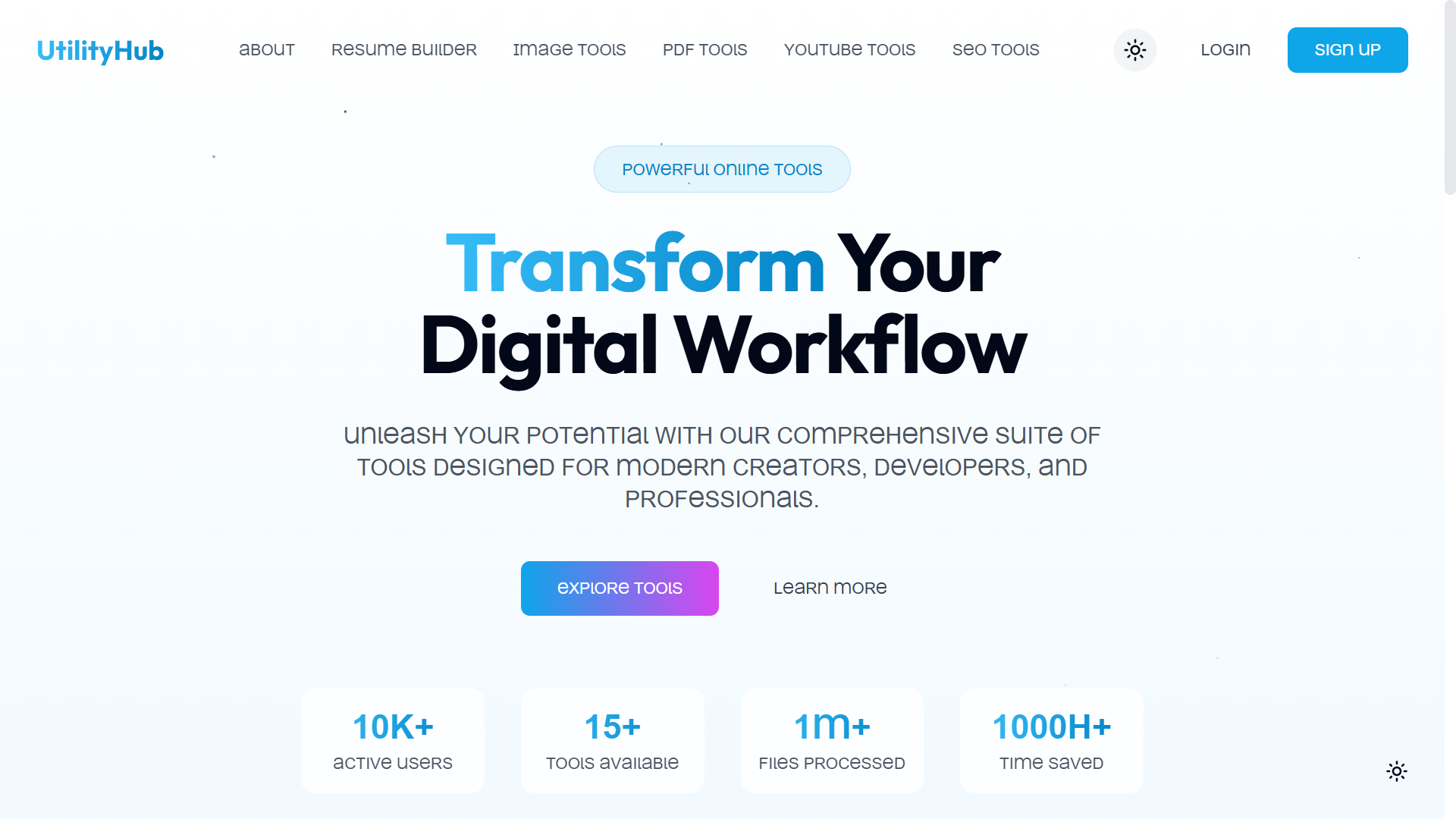
About UtilityHub
UtilityHub is a free, all-in-one online toolbox built in 2024 by a passionate developer who had just mastered Next.js. This project was born as a real-world test of skills — combining modern web technologies to build something fast, useful, and SEO-powerful.
When Was UtilityHub Built?
UtilityHub was built in 2024 — right after mastering Next.js. It was created as a hands-on, production-grade project to test and showcase full-stack skills using the latest web technologies. The goal was simple: build something real, fast, and actually useful to people.
Why Next.js?
Next.js was the obvious choice for UtilityHub for one major reason — SEO. Unlike plain React apps, Next.js supports Server-Side Rendering (SSR) and Static Site Generation (SSG), which means every page is fully crawlable by search engines like Google right out of the box.
Beyond SEO, Next.js makes developer life significantly easier:
File-based routing — no need to manually configure routes
API Routes — build backend endpoints inside the same project
Automatic code splitting — pages load only what they need
Image optimization — built-in
<Image>component for performanceFast build times with Turbopack support
After mastering Next.js in 2024, UtilityHub became the perfect first big project to apply all of these concepts together in one real, deployed application.
Why Tailwind CSS?
Tailwind CSS was chosen because it removes the friction of writing custom CSS files. Instead of jumping between stylesheets, you style components directly in JSX with utility classes — making UI development incredibly fast and consistent.
No CSS files to manage — everything is inline utility classes
Fully responsive — mobile-first design with breakpoint prefixes
Dark mode support built-in out of the box
Tiny production bundle — Tailwind purges unused styles automatically
Consistent design system — spacing, colors, and typography stay uniform
Paired with Next.js, Tailwind made it possible to build a polished, professional UI for UtilityHub in a fraction of the time it would take with traditional CSS or a component library.
Why Firebase & Firestore?
Firebase was chosen for UtilityHub's backend because the developer was learning Firebase Firestore at the time and wanted to apply it in a real project. It was the perfect opportunity to go from beginner to builder.
Firebase handled both authentication (Login & Sign Up) and database storage (Firestore) — all without needing to set up a custom backend server.
Firebase Authentication — easy email/password login and sign-up system
Firestore (NoSQL Database) — flexible, real-time database that scales automatically
No server needed — Firebase manages all backend infrastructure
Free tier — perfect for a beginner project with real users
Real-time updates — data syncs instantly across the app
Using Firebase while still learning it was a deliberate decision — the best way to master a technology is to build something real with it. UtilityHub is proof of that.
Why React Libraries?
One of the biggest advantages of the React ecosystem is the massive collection of open-source React libraries available. Instead of reinventing the wheel, UtilityHub leverages battle-tested libraries to speed up development and improve quality.
Here's why using React libraries was a smart choice:
Speed up development — solve complex UI problems in minutes, not days
Reliability — community-maintained libraries are tested by thousands of developers
Less boilerplate — write less code and focus on features that matter
Better UX — polished animations, drag-and-drop, file handling made easy
Maintainability — well-documented libraries are easier to update and debug
For a solo developer building 15+ tools, React libraries were not optional — they were essential to shipping a production-quality product efficiently.
UtilityHub Tech Stack at a Glance
Framework: Next.js — SEO-first, fast, file-based routing
Styling: Tailwind CSS — utility-first, responsive design
Database: Firebase Firestore — NoSQL, real-time, serverless
Auth: Firebase Authentication — secure login & sign-up
UI Components: React Libraries — faster, cleaner, production-ready UI
Hosting: Vercel — zero-config deployment for Next.js
Ready to Explore the Tools?
UtilityHub is completely free with no ads and no hidden costs. Whether you're a student, developer, creator, or professional — there's a tool here for you.